CAREERS IN PHOTOGRAPHY
This section of my portfolio will discuss careers in photography and my personal experience in the field.
Photography courses include composition of photographs using digital or even darkroom techniques to manipulate images. Many people choose careers in photography or involving photography as it unleashes their passion and love for the arts. Photography can go as far as editing, colouring, visual effects to the historical and social impact of the arts.
Some courses in photography are more hands-on and practical where your would spend most of your time creating films/photographs whilst others are more theoretical, where you would study history, theory and social contexts of photography and film. For this reason, it is crucial thorough research is done into different courses in photography and then a brief analysis into the modules to avoid disappointment in the course.
Preferred Subjects for a career in photography:
-
Media Studies
-
Art & Design
-
Photography
-
English
-
Film Studies
-
Drama & Dance
-
Psychology
-
History
-
Mathematics
-
Business & Marketing
Most people who end up with a degree in photography have more emphasis placed on their transferable skills – these include analysis skills; communication skills; commercial awareness; self-motivation; the ability to work with others. These skills are sought by employers in film, publishing, television, public relations, photography, design, computing, education and the arts.
STATISTICS:
Average salary 15 months after graduating: 20,489 GBP
Graduate jobs: 57%
MY EXPERIENCE:
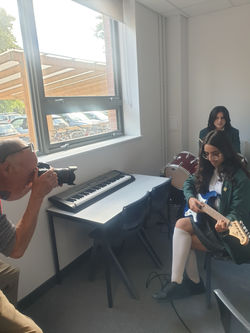
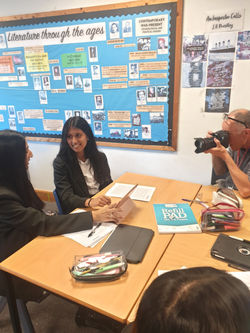
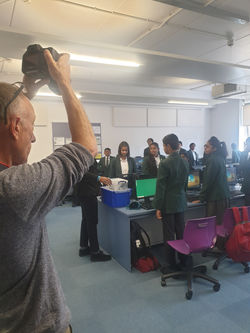
I was given the opportunity to shadow the school photographer as a means of gaining invaluable experience in the field of photography. The school photographers task was to capture meaningful pictures in line with the school ethos for the school website. During my shadowing, I took many pictures and photographed in many locations around the school, such as music rooms, art rooms, the courtyard, the field and even the roof!
The Music Room:
 |
|---|
 |
 |
 |
 |
 |
 |
 |
 |
 |
The English Room:
 |
|---|
 |
 |
 |
 |
 |
 |
 |
 |
 |
 |
The Computer Rooms
 |  |  |
|---|---|---|
 |  |  |
 |  |  |
 |  |  |
 |  |  |
 |  |  |
 |  |  |
 |  |  |
 |  |  |
 |
Outside the School:


The school photographer told me to experiment with panorama shots using my phone, as it allows more image to be displayed whilst experimenting new techniques.

QA WITH THE PHOTOGRAPHER
During my time shadowing the photographer, I asked many questions, to which I received insightful and detailed answers.
Q) What mode for exposure do you set your camera to when taking photographs?
A) Well, usually, the camera automatically sets it to manual, and this has optimal settings. However, there are some cases when manual mode does not work as expected and so I must manually adjust it. In a setting with low light, I set the exposure to positive, and in a setting with too much light, I set the exposure to negative.
Q) How are you going to photograph the whole school landscape?
A) Typically, you would use panorama settings however on my DSLR, I do not have the option to do this and hence what I have to do is take multiple shots and then stitch them together. I can also blur out any undesired areas such as minor eyesores.
Q) How do you select what images to finalise?
A) Well, if I consider my previous school photoshoot, I took 1500 images and out of all of those, I kept 250! The criteria has to be strict to decide what images to keep: delete any images with unconsented people; delete images with peoples eyes closed/blinking; delete multiple shots in one style.
Q) How do you deal with the gender imbalance in some settings?
A) With smaller groups, you can easily swap male/female students around to give the perceived balance we would usually desire, however, in certain settings, such as larger groups, this is sometimes not possible. For example, today in the English class we were photographing, majority of the class was female with the exception of two male students – in this case, we tried to get as many pictures of the mixed tables as possible but in some situations, it wasn’t possible and so the photography had to reveal the situation as it is.
REVIEW:
Through my extensive research in photography, I have come to the conclusion that photography is an artistic and broad subject that can be studied and most importantly, put into practice, through practical work and doesn't necessarily require qualifications to succeed in - you could do it alongside your main career.
Photography, to me, is a form of expressionism, where certain things sometimes only appeal to select people. This makes the process of photographing enjoyable as well as challenging, as sometimes you may want to send a message across to your audience. In this case, photography requires careful planning, such as with the school photographer, who had to get the school ethos across.


Me shadowing the school photographer and mimicking his angles and styles.
LEARNING POINT: PANORAMA'S
Panorama photography is also known as wide format photography and is a special technique that stitches multiple images from the same camera together to form a single, wide photograph (vertical or horizontal). The term “panorama” literally means “all sight” in Greek. When the ratio between height and length of the photo is at least 1/2, we consider it a panoramic photography.
